


I’m going to be painfully honest here: When I arrived in Indianapolis to work for The Star in 2000, I knew absolutely nothing about motorsports. And having grown up in New York (and Chicago for my last two years of high school), I cared even less. Even when I attended IU from 1978-82, I paid little to no attention to the sport, having attended the race just once when we got a buddy’s RV and spent the entire morning and afternoon partying our ever-loving brains out, completely ignoring the action on the track.
I remember when I took the job, my editor-in-chief at the time told me not to worry about my lack of motorsports expertise, saying, “You’ll figure it soon enough.” Much to my chagrin, one of my first columns the summer of 2000 was on the Brickyard 400, which was a complete mystery to me. Then, about a year later, Dale Earnhardt, Sr. tragically passed during the 2001 Daytona 500, and my column fully reflected my lack of understanding of the sport and the men (and women) who compete so heroically nearly every weekend. The piece was, in a word, awful.
Now, 27 years later, I still can’t claim that I know the sport any better than I do the stick-and-ball sports. And again, full honesty, I still don’t pay much attention to races that aren’t the Indianapolis 500. If there’s a hockey or basketball game and a race on TV, there’s no question what I’m watching.
Having said all of that, I will say this now: After almost three decades of covering the event, I love the Indianapolis 500.
I do.
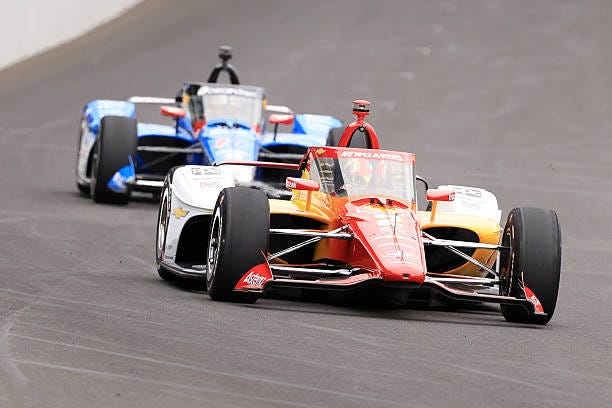
I love the driver introductions, notably the Alexander Rossi introduction, when he was helped to the podium by his first-row competitors after a frightening crash and resulting injuries this week. I get choked up listening to “Taps” and then “Back Home Again In Indiana,” whether it was Jim Nabors or, currently, Jim Cornelison. The flyover always gets to me. And there is no sound in sport quite like the guttural roar of the great machines when the drivers are told to “start your engines.”
And I’m reasonably proud to say, some of my best work has come during the run-up to the race, including two pieces for The Athletic, one a story about Rossi, who’d won the 100th running of the 500, and an oral history of Mario Andretti’s one and only Indy 500 victory 50 years earlier. One thing I learned rather quickly is you’re writing about people doing extraordinary things. What these folks do is completely insane and noble, flying chassis-to-chassis, nose-to-tail around a superspeedway at 220 miles per hour, putting life and limb on the line every time they got behind the wheel. As the years have worn on, I’ve come to find drivers and the people in the paddock to be some of the most fascinating humans on the planet.
This sport requires the ultimate bravery, as we saw Sunday when Felix Rosenqvist beat crestfallen David Malukas by half a car length, winning the race by .0233 seconds, the closest finish in Indianapolis 500 history. It bypassed Al Unser, Jr.’s 1992 victory over Scott Goodyear by .043 seconds. It came down to a one-lap shootout, which is basically all you can ask from the Greatest Spectacle in Racing. The pass at the end was the 70th of the race, setting the record for most lead changes in Indy 500 history.
I mean…wow.
When it was over, Rosenqvist, the third-ever Swedish driver to win this race and a newly-minted father, was overjoyed while Malukas, the talented 24-year-old American and back-to-back second-place finisher, could not stop the tears. And it was deeply moving, revealing both ends of the emotional spectrum. Think about it: .0233 seconds. That’s an eyeblink – less than an eyeblink, actually, which takes one-third of a second, especially at 220 miles per hour. All those stops and starts, yellow flags and red flags and crashes and all the rest, and this is what it came down to. One more go-for-broke pass in the final couple of yards of track, which revealed the chasm between ultimate joy and gut-wrenching heartbreak.
This race had everything, from balls-to-the-wall racing to multiple strategies as drivers and their teams tried to beat the rain that never really came in earnest until hours after the race’s end.
This is why I’ve learned to love the Indianapolis 500.
It never disappoints.
###
